
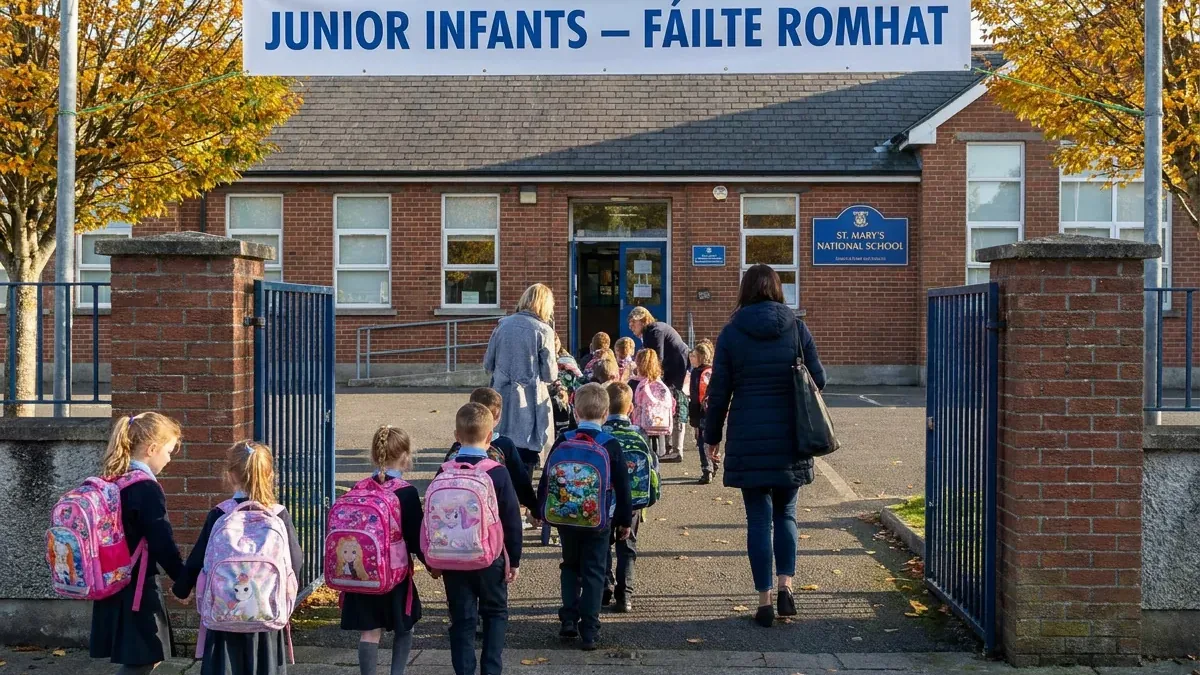
Working out when to start junior infants, and which school to send your child to, is one of those decisions that can sit at the back of your mind for months. You want to get the timing right and pick a school that genuinely suits your child, without missing an enrolment deadline along the way.
The good news is that Irish law gives you more structure here than it might feel like. This guide covers the age most children start, the main types of primary school you can choose between, and what enrolment law actually requires of schools. If you need childcare to bridge the gap around the school day, our Find a School tool and our wider carer search both sit alongside this guide.
What age children start junior infants in Ireland
Most children in Ireland start junior infants, the first year of primary school, at age 4 or 5. Formal education becomes compulsory by age 6, according to Citizens Information’s guide to starting primary school, but the majority of families enrol well before that, starting in September following the child’s fourth birthday.
There’s no single “right” age within that window. Some children thrive starting junior infants at 4, others benefit from an extra year at pre-school first. If you’re weighing it up, talk to your child’s pre-school or crèche key worker. They’ll usually have a good sense of readiness signals like following group instructions, managing toilet independence, and separating from a parent without distress.
Once your child is settled into junior infants, the routine itself is a big adjustment too, both for them and for how your week is structured around drop-off and pickup.
Choosing the right type of primary school
Ireland doesn’t have one single kind of primary school. Most primary schools are denominational, run under a Catholic or Church of Ireland patron, but that isn’t the only option available to you. Understanding the main types of schools in Ireland, and which patron runs each one, makes it much easier to shortlist honestly rather than default to whichever school is nearest.
- Educate Together schools: multi-denominational Irish schools, with children of all faiths and none learning together and no religious instruction built into the core day.
- ETB Community National Schools: run by local Education and Training Boards across Ireland, also multi-denominational and state-run.
- Gaelscoileanna: teach the full national curriculum through Irish, found throughout Ireland. A Gaelscoil is often patronised by An Foras Pátrúnachta and may carry a religious or non-religious ethos depending on the individual school.
Multi-denominational schools remain a minority nationally, so availability varies a lot by area. It’s worth checking what’s actually within reach of your home before you settle on a preference, since a school type you like on paper may mean a longer commute than a school type you’re less sure about.
What the law says about enrolling your child
School admissions in Ireland changed significantly under the Education (Admission to Schools) Act 2018. Every recognised school must publish a written admissions policy, and that policy has to apply fairly and consistently to every applicant.
Two protections are worth knowing before you apply:
- No admission fees. Schools cannot charge, or ask for a contribution, simply to process your application or continue your child’s enrolment.
- No selective interviews. Schools cannot interview your child, assess their academic ability, or take your occupation or financial circumstances into account when deciding who gets a place.
Where a school has more applicants than places, it must use published, non-discriminatory selection criteria, not personal judgement about individual families. If a school’s process doesn’t match this, that’s a legitimate reason to ask questions before you commit to that school.
Supporting additional needs when choosing a school
If your child has additional or special educational needs, the type of class matters as much as the type of school. The National Council for Special Education (NCSE) sets out three broad options: a mainstream class, a special class attached to a mainstream school, or a dedicated special school.
A Special Educational Needs Organiser (SENO) can talk you through which setting suits your child and help with the application process for a special class or special school place. Our guide on supporting a child with special needs covers the wider picture beyond school choice, including everyday routines and where else to find support.
Registering for junior infants before the deadline
Most schools open applications for the following September well over a year in advance, so it’s worth contacting your preferred schools directly for their exact dates rather than assuming a single national deadline. Ask each school for:
- Their published admissions policy and selection criteria, if oversubscribed
- The exact application window and required documents
- Whether they run an open evening or tour for prospective parents
The admissions rules behind that policy come from the Education (Admission to Schools) Act 2018, which you can read in full on the Irish Statute Book alongside the Department of Education’s own admissions guidance.
Junior infants classes typically run a shorter day than older primary classes, especially in the first term. If you need cover before or after school, our guide to carer pay rates in Ireland is a useful starting point for budgeting, and our piece on finding a trustworthy babysitter covers occasional after-school cover specifically.
Bringing it together
Starting junior infants is a big step, but it’s a well-trodden one. Most children start at 4 or 5, schools fall into a handful of clear types, and the law now gives every family the same fair shot at a place, regardless of income or background.
Once you’ve settled on timing and school type, you can search for local schools through Find a School, and line up any wraparound care through a Garda-vetted carer on TrustedCarers.ie.
FAQ
Q: What age do children start junior infants in Ireland?
A: Most children start at age 4 or 5, typically in September following their fourth birthday. Education only becomes legally compulsory at age 6, so families have some flexibility either side of that.
Q: What’s the difference between a Gaelscoil and an Educate Together school?
A: A Gaelscoil teaches the national curriculum through Irish and may carry a religious or non-religious ethos depending on the school. An Educate Together school teaches through English, is multi-denominational, and has no religious instruction built into the core day.
Q: Can a school charge a fee to apply for a place?
A: No. Under the Education (Admission to Schools) Act 2018, schools cannot charge or request a contribution simply to process an application or continue an existing enrolment.
Q: Can a school interview my child before offering a place?
A: No. Schools cannot conduct selective interviews, assess a child’s academic ability, or consider a parent’s occupation or financial circumstances as part of an admissions decision.
Q: Who can help if my child has additional needs and I’m choosing between school types?
A: A Special Educational Needs Organiser (SENO), coordinated through the NCSE, can advise on mainstream classes, special classes, and special schools, and help with the application process for whichever setting suits your child.


Leave a Reply