
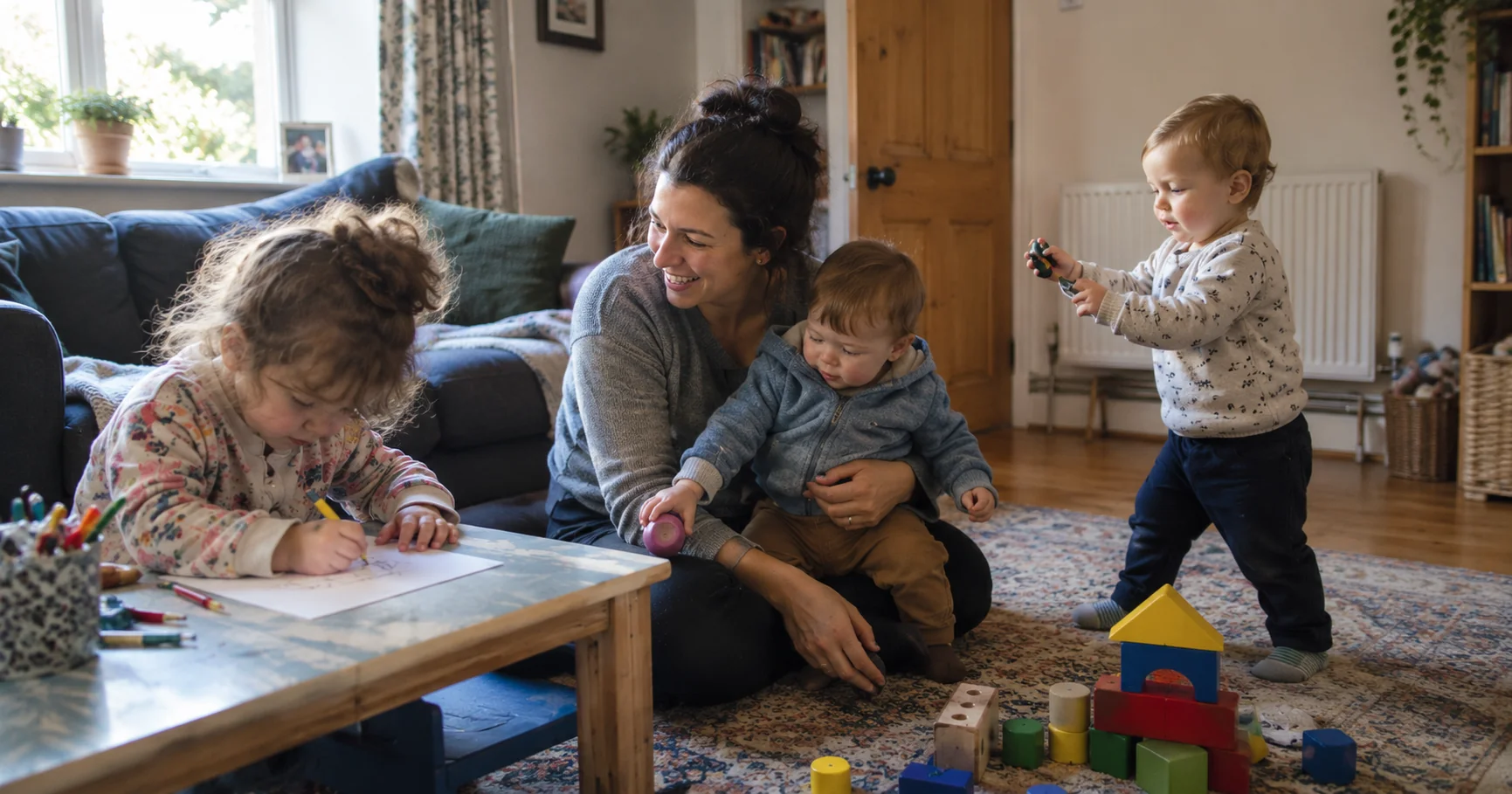
You have found a childminder with good references and a home you liked the feel of, but you are still not quite sure what does a childminder do across a full day, and whether it matches what your child actually needs. It is a fair thing to want pinned down before you hand over the week, and comparing it against your other childcare options is exactly the right instinct.
The good news is that a childminder’s day follows a fairly predictable shape once you know what to look for.
Key Takeaways
– A childminder gives regular, hands-on care in their own home, built around meals, play, rest and the school run.
– The role is defined care during agreed hours, not housekeeping, tutoring or evening babysitting.
– What a childminder can do is shaped by Tusla ratios: up to 3 preschool children and 6 in total.
– Ask about a normal day, not just qualifications, before you commit.
What does a childminder do, in one line
A childminder looks after your child in the childminder’s own home during agreed hours, keeping them safe, fed, occupied and on a steady routine. Everything else is detail hanging off that one job.
That home setting is what makes the day feel different from a creche. The group is small and mixed in age, so the rhythm bends around the children actually there that day rather than a fixed timetable for one age band. For many parents that flexibility is the whole point.
A typical childminder’s day, hour by hour
No two days are identical, but the shape rarely changes much. Here is what the role of a childminder usually looks like from drop-off to pick-up.
Mornings
The day starts with arrivals, breakfast for anyone who needs it, and settling in. Younger children move into play or an outing; a childminder often has a walk, a playground trip or a structured activity planned for late morning before lunch.
Midday
Lunch, then naps for the little ones and quieter activities for anyone who has dropped their daytime sleep. This is the calm middle of the day, and a good childminder uses it for one-to-one time: reading, drawing, simple learning through play.
Afternoons
The afternoon often includes the school or creche run, so a school-age child joins the group. Snack, more play, tidy-up, and a wind-down before parents arrive. You should expect a quick handover on how the day went.
What does a childminder do that a creche or babysitter does not
So what does a childminder do that the others don’t? This is where the role gets clearer by contrast. A childminder sits between a creche and a babysitter, and does something neither quite offers.
| Care type | What they mainly do | Best for |
|---|---|---|
| Childminder | Regular daytime care at home, small mixed-age group | A steady weekday routine |
| Creche | Structured, age-banded care in a regulated centre | Timetabled group care |
| Babysitter | Occasional, often evening cover | One-off or evening needs |
A babysitter gives occasional cover, while a creche gives structured, age-banded care in a larger regulated setting. A childminder can flex to your child’s needs in a way a fixed timetable cannot. If you are weighing these side by side, our guide to childcare options in Dublin lays out the trade-offs in one place.
What a childminder does not do
Knowing the boundaries matters as much as knowing the duties. A childminder is not a housekeeper, so deep-cleaning your home is not part of the job. A childminder is not a tutor, though many support homework informally. And a childminder is not an on-call babysitter for nights out, unless you agree that separately.
Being clear on this upfront protects both sides. It keeps the arrangement predictable, which is exactly what makes regular care work.
How registration shapes what a childminder can do
What a childminder is allowed to do is partly set by regulation. Under the 2024 Childminding Regulations, a childminder is currently exempt from Tusla registration if caring for no more than three preschool children and no more than six children in total, including their own.
That ratio is not red tape for its own sake. It is what keeps the group small enough for the personal attention that defines the role, and the thresholds are set out in Tusla’s childminding guidance. When you meet a childminder, it is worth asking how many children they mind and what ages, so you know the group your child would join. You can see how this plays out locally in our look at childminders in Dublin.
What to ask about a childminder’s day before you hire
The fastest way to understand what a childminder does for your child specifically is to ask about a normal day, not just their qualifications. A few questions worth asking:
- Walk me through a typical day: what does a childminder do here from morning to pick-up?
- How many children are usually in the group, and what ages?
- How do you handle meals, allergies and naps?
- Do you do the school run, and does that suit our timing?
- How will you tell me how my child’s day went?
Our guide to employing a childminder covers the practical side, from agreeing hours to sorting the paperwork.
Once you know the day suits your family, you can find a Garda-vetted childminder on TrustedCarers.ie and compare real profiles against what you have read here.
Frequently asked questions
Q: What does a childminder do all day?
A: A childminder cares for children in their own home during agreed hours, covering meals, play, rest, outdoor time and often the school run. The day is built around a small, mixed-age group rather than a fixed timetable.
Q: What is the role of a childminder?
A: The role of a childminder is to give regular, safe, hands-on care at home during agreed hours. It covers a child’s daily needs but not housekeeping, tutoring or evening babysitting unless separately agreed.
Q: Does a childminder do the school run?
A: Often, yes, where it is part of the arrangement. A childminder frequently collects school-age children in the afternoon, but you should confirm this fits your timing before you commit.
Q: Do childminders cook meals?
A: Yes. Preparing meals and snacks, and managing any allergies or dietary needs, is a normal part of what a childminder does day to day.
Q: How many children does a childminder look after?
A: Up to three preschool children and six children in total, including their own, before Tusla registration is required. Many childminders keep the group smaller than that.


Leave a Reply